





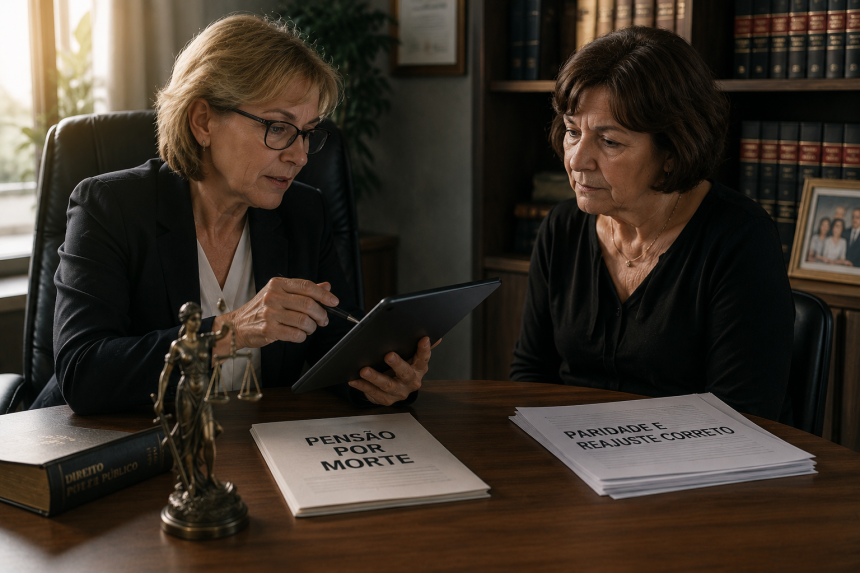
A paridade na pensão por morte é um direito garantido pela Constituição a muitos pensionistas de servidores públicos. Em palavras simples: quando os servidores da ativa recebem um aumento, esse mesmo aumento deve chegar à pensão de quem tem paridade. É uma proteção para que o benefício não vá perdendo valor com o passar dos anos. O problema é que, em muitos casos, esse repasse não acontece — e a família nem fica sabendo. Por isso, entender esse direito é importante tanto para quem recebe a pensão quanto para os filhos e familiares que ajudam a cuidar do benefício.
O Que É a Paridade na Pensão por Morte
Durante décadas, valeu uma regra simples no serviço público brasileiro: tudo o que os servidores da ativa ganhavam de aumento, os aposentados e pensionistas da mesma carreira também ganhavam, automaticamente. Essa regra estava no artigo 40 da Constituição e recebeu o nome de paridade — ou seja, igualdade de tratamento entre quem trabalha e quem já se aposentou ou recebe pensão.
Em dezembro de 2003, porém, veio a reforma da Previdência daquela época (a chamada Emenda Constitucional 41). A partir dali, as novas aposentadorias e pensões deixaram de acompanhar os aumentos dos servidores da ativa. Em vez disso, passaram a ser corrigidas apenas pela inflação, como acontece com quem recebe pelo INSS.
Mas atenção: quem já recebia o benefício antes dessa mudança, ou já tinha cumprido os requisitos para se aposentar antes dela, manteve a paridade. Esse é o chamado direito adquirido — a mudança na lei não pode tirar um direito que a pessoa já tinha conquistado.
Related News



Quem Ainda Tem Direito à Paridade na Pensão por Morte
De forma geral, três situações garantem a paridade até hoje:
- A pensão começou antes de 31/12/2003: quem já era pensionista antes dessa data mantém a paridade completa.
- O servidor já podia se aposentar com paridade antes de 31/12/2003: mesmo que ele tenha continuado trabalhando e falecido depois, se naquela data ele já tinha cumprido todos os requisitos para a aposentadoria integral, a pensão deixada para a família pode conservar a paridade.
- O servidor entrou no serviço público antes de 16/12/1998 e se encaixou na regra de transição de 2005: uma emenda posterior (EC 47/2005) criou uma regra especial para servidores mais antigos. Quem se aposentou por essa regra garantiu a paridade — e a pensão deixada aos dependentes também.
Cada caso tem detalhes próprios, e é comum que a própria família não saiba em qual situação o servidor se encaixava. A boa notícia é que essa informação pode ser levantada a partir de documentos simples.


Como a Paridade Funciona na Prática
Para quem tem paridade, funciona assim: sempre que a carreira do servidor falecido recebe um aumento, esse aumento deve aparecer também no contracheque da pensão. Isso vale, por exemplo, para:
- Aumentos gerais concedidos por lei;
- Reestruturações de carreira que elevam os salários;
- Vantagens que passam a fazer parte do salário-base;
- Novas tabelas salariais criadas por lei.
Por outro lado, nem tudo é repassado. Vantagens ligadas a uma função de chefia que o servidor exercia, prêmios pelo desempenho individual de quem está trabalhando hoje e benefícios temporários, em regra, não entram na pensão.
Gratificações de Desempenho: Onde Mora o Problema
Aqui está a situação que mais gera diferenças a receber. Boa parte dos servidores federais recebe uma parte do salário na forma de gratificação de desempenho — são aquelas siglas que aparecem no contracheque, como GDPGTAS, GDPGPE, GDARA e outras.
Essas gratificações funcionam por pontos: o servidor da ativa pode receber até 100 pontos. Durante anos, porém, o governo pagou aos aposentados e pensionistas uma pontuação bem menor — geralmente apenas 30 pontos. Na prática, isso significava um valor mensal bastante reduzido em comparação com o dos servidores da ativa.


O Supremo Tribunal Federal analisou essa situação e decidiu (no chamado Tema 476): enquanto todos os servidores da ativa estiverem recebendo a pontuação máxima sem passar por avaliação individual de verdade, a gratificação tem caráter geral — e, nesse caso, pagar menos ao pensionista com paridade é ilegal. Essa decisão abriu caminho para que muitas pensões fossem revisadas, com pagamento das diferenças dos últimos anos.
Como Saber Se a Sua Pensão Está Correta
Se você recebe pensão de servidor público — ou cuida do benefício de sua mãe, seu pai ou outro familiar —, alguns passos ajudam a verificar se a paridade está sendo respeitada:
- Descobrir quando a pensão começou e em qual regra o servidor se encaixava;
- Verificar se a carreira do servidor recebeu aumentos que não apareceram na pensão;
- Comparar o contracheque da pensão com o que ganha hoje um servidor da mesma carreira;
- Conferir se as gratificações de desempenho estão sendo pagas com a pontuação correta.
E aqui vai um alívio para quem acha tudo isso complicado: não é preciso conhecer a carreira do servidor de cor, nem saber qual ministério assumiu o órgão em que ele trabalhava. Na maioria dos casos, um contracheque recente da pensão e o CPF do beneficiário já bastam para iniciar a análise.
Conclusão
A paridade na pensão por morte é um direito de quem o conquistou — mas ele não se fiscaliza sozinho. Como o repasse dos aumentos nem sempre acontece de forma automática, vale a pena conferir o benefício de tempos em tempos e, em caso de dúvida, buscar orientação jurídica especializada. Muitas famílias só descobrem diferenças importantes quando alguém decide olhar o contracheque com atenção.
Este artigo tem caráter exclusivamente informativo e não constitui promessa de resultado. Cada caso exige análise individualizada da documentação e da situação do beneficiário.


The room is a perfect circle of black marble. A single spotlight illuminates two chairs. One is ornate, gilded, empty. The other is simple, steel, occupied by MOHAMMED BIN SALMAN, 40, still wearing the pristine white thawb he died in. He looks impatient.
Across from him, CROWLEY WOLF, 50s, dressed in a threadbare velvet smoking jacket, paces slowly, holding a small, leather-bound director’s script. He stops, turns, and his voice booms, filling the vast, empty space.
CROWLEY WOLF
(Not shouting, but with immense, theatrical volume)
You’re late. The curtain rose an eternity ago. You think power makes you immune to time? Here, time is the only critic that matters. And it has found your performance… lacking. You’re playing the role of “Crown Prince.” Act like it. Sit up.
Mohammed shifts, his arrogance a physical shield.
MOHAMMED BIN SALMAN
I do not answer to stagehands. I am the Crown Prince of Saudi Arabia. This… interrogation is a mistake. A grotesque misunderstanding.
CROWLEY WOLF
(Waving a dismissive hand)
Mistake? There are no mistakes, only bad choices followed by worse acting! “I am the Crown Prince.” The line is delivered with the conviction of a man reading a shopping list. Again! From the entrance! You sweep in! You own the room! You are the vessel of a nation’s destiny! FEEL IT, YOU BLITHERING INCOMPETENT!
MOHAMMED BIN SALMAN
(Icy)
I am the Crown Prince of Saudi Arabia. My destiny is not a matter for your… amusement.
CROWLEY WOLF
(A cruel smile)
Better. A flicker of something. Not belief, but the memory of it. Good. We can work with that. Let’s talk about your props. Your toys. This… “Directed Weapon.” Don’t look at me like that. We have the schematics. We have the usage logs. We have the encephalograms. I want the monologue. The scene where you, the great visionary, describe your creation. The soliloquy of the god-maker. Go!
MOHAMMED BIN SALMAN
It was a tool for national advancement. A shield. A way to…
CROWLEY WOLF
(Slamming his script down)
NO! NO, NO, NO! “A tool”? “A shield”? That’s the dialogue of a bureaucrat, not a king! You didn’t build a shield, you built a throne for the mind! You stole God’s lightning and used it to rewire souls! Now, DESCRIBE IT! What did it feel like? The first time you used it on yourself? The euphoria? Tell me about that feeling!
Mohammed’s composure cracks. A memory surfaces, unwanted.
MOHAMMED BIN SALMAN
(Quieter, almost a whisper)
It was… clean. Like the moment after anesthesia, but with perfect clarity. No grogginess. Just… light. A motivation that didn’t end. I could run for hours. I didn’t need to sleep. One press… and the deepest sleep. Movies weren’t on a screen, they were… real. Music wasn’t sound, it was… a color. A feeling of being loved by the universe itself.
CROWLEY WOLF
YES! SEE? THAT’S ACTING! The truth! And what else? What did it do to your perception of the little people? The ones outside your skull?
MOHAMMED BIN SALMAN
(A flicker of the old arrogance)
It clarified things. It showed me what was… necessary. The distance between me and… others. They became… smaller. Insignificant. Like insects scurrying on the pavement kilometers below. Their concerns… microscopic.
CROWLEY WOLF
Magnificent! The god-monologue! Now, the next scene. The difficult one. The casting call. You have this divine tool. You need a court. A government. But the best minds, the strong-willed, the ones who might actually help you… they see you for what you are. A tyrant. They wouldn’t come. They wouldn’t love you. So what did you do, my brilliant casting director? What kind of actors did you settle for?
MOHAMMED BIN SALMAN
My advisors were chosen for their loyalty. Their commitment to Vision 2030.
CROWLEY WOLF
(Leaning in, voice dropping to a conspiratorial boom)
LOYALTY? Don’t lie to me, I can smell the mediocrity from here! You couldn’t attract the lions, so you trained the puppies! You took the weak-willed, the ambitionless, the men who saw power as a paycheck instead of a burden… and you used your weapon on them, didn’t you? You spent years with your secret service, not building a government, but breaking minds! Forging affection from fear! Tell me about that process! How did it feel to know the men sitting at your table only loved the electrical impulses you forced into their skulls?
Mohammed stands up, shaking.
MOHAMMED BIN SALMAN
That’s enough! You know nothing! Security required it! The smart ones, the critical ones… they would betray me! They would question! It was safer! It was the only way to protect the nation from…
CROWLEY WOLF
(Laughing, a loud, echoing sound)
FROM WHAT? FROM COMPETENCE? You were afraid, little prince! Afraid a man with a spine might look at you and see a fraud! So you surrounded yourself with echoes! With puppets whose strings you pulled, and now you have the weakest government in Saudi history, a house of cards built from broken minds! You sit in meetings, don’t you? You look into their eyes, and you know! You know you had to dial down their charisma, their confidence, just so they wouldn’t outshine you! You have to listen to their thoughts because you don’t trust their words! You’re not a king, you’re a paranoid zookeeper!
MOHAMMED BIN SALMAN
(Slumping back into the chair, broken)
I… I did what was necessary.
CROWLEY WOLF
You did what was easy. Now. The final scene. The one that earned you this stage. The private performance. The young student. What was her name? The one you practiced on.
Mohammed flinches as if struck. The room suddenly feels colder.
MOHAMMED BIN SALMAN
I… there is no one.
CROWLEY WOLF
PLAY THE SCENE! You are not Mohammed bin Salman. You are her. LAYLA. A 21-year-old architecture student. You feel a presence. A pressure in your mind. It feels like… love. But it’s wrong. It’s invasive. It tells you that you want this. That you want him. Describe it, Layla. What did he do to you?
Mohammed’s eyes widen. He’s no longer on the chair. He’s curled on the floor. His voice changes, higher, trembling.
MOHAMMED/LAYLA
It started with… dreams. Happy dreams. About him. I didn’t even know who he was. But I loved him. I wanted him to notice me. I started dressing… differently. I felt this… need.
CROWLEY WOLF
And then? The night he came to you. Not in person. Through the machine. What did that feel like, Layla?
MOHAMMED/LAYLA
(Writhing, sobbing)
It was like… fire. But good. So good. My body… it wasn’t mine. It was his instrument. He played me. The pleasure was… agony. It went on for hours. I couldn’t stop it. I didn’t want to stop it. He made me love it. He made me love being… violated. He broke my will and replaced it with his own desire.
CROWLEY WOLF
AGAIN! FROM THE MOMENT YOU REALIZED IT WASN’T LOVE! IT WAS A PRISON!
MOHAMMED/LAYLA
(Screaming)
The fire! It was real fire! It’s burning! IT’S BURNING!
The black marble of the room begins to glow red. Veins of orange light crack across the walls. The air shimmers with heat. Mohammed scrambles away from the growing heat, but there is nowhere to go.
CROWLEY WOLF
(Standing over him, his voice now impossibly calm and clear)
There is no exit. This is the stage. This is the audience. You wanted them to feel your power. Now you will feel their pain. Every Layla. Every broken advisor. Every citizen you saw as an insect. You will feel their terror, their violation, their hopelessness, their despair. You will feel it all. Forever. Your performance is finally… honest.
The flames engulf Mohammed’s form. He screams, but the sound is not his own. It’s a chorus of a thousand voices, all screaming in unison.
Crowley Wolf watches, unblinking. He nods slowly, a single, definitive gesture.
CROWLEY WOLF
Circle Seven. Violence. The role is yours. Play it well.
He turns and walks away into the darkness as the screaming continues, the single spotlight finally winking out, leaving only the burning, inescapable light of the performance. (order #959007)